


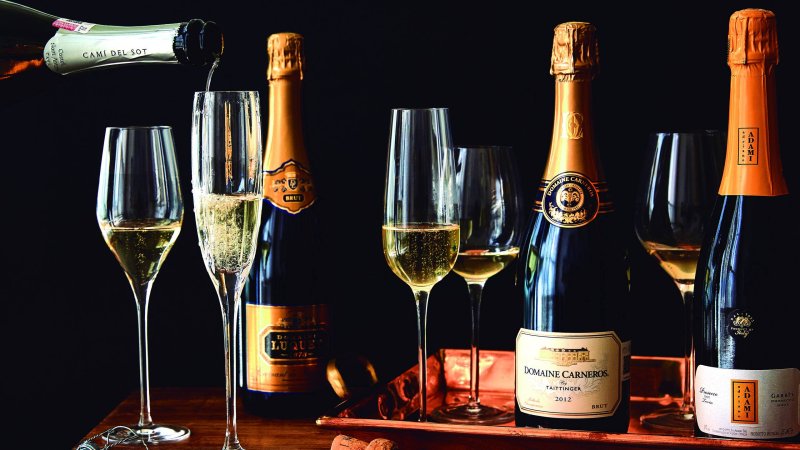
What is a sparkling wine?
It is important to know that both drinks are sparkling wines. Knowing that, we have to say that sparkling wine is simply a white wine that contains natural carbon dioxide. To achieve this, it undergoes a second fermentation that gives the drink the bubbles that we like so much. It is important to know that champagne and cava are made with two red grapes and one white. That said, sparkling wine is achieved by carrying out a first fermentation like traditional wines, but then another fermentation is added through the method called champenoise. This method can be done when yeast is added. At the same time, it is important to emphasize that aging is always carried out in bottles, that is, aging is not carried out in barrels.How is champenoise made?
To make champenoise, a method that allows us to obtain cava or champagne as a result, it makes us go through four steps or phases. We present them to you below so that you can learn more about them.First phase
This phase consists of creating the base of the wine through the combination of the three types of grapes. Normally the variety Pinot Noir, Chardonnay and Pinot Meunier is used. It is important to always use the right combination to achieve the desired flavor and alcohol level.Second phase
It is linked to bottling. This means that it is the moment in which the base wine is mixed with the tirage liquor inside the glass bottle. It is important to remember that the second fermentation takes place inside the bottle. It is important that the bottling is adequate to certify that the wine will be able to ferment a second time. Likewise, the lid must be of quality because otherwise the carbon dioxide characteristic of this variety of drink could not be created.Third phase
Refers to the fermentation of the drink. For this fermentation to be possible, it is important that the drink is inside the bottle for a minimum of nine months. During that time what you want is for the yeast to eat the sugar. That movement creates more alcohol and carbon dioxide. It is important to remember that gas is what creates the bubbles that we like so much when enjoying a glass of cava or champagne. As you can see in our online store, there are different types of fermentation depending on the aging period.- Young: 9-15 months
- Reservation: 15-30 months
- Large reserve: more than 30 months
Fourth phase
It is linked to the slaughter. The bottle is frozen, opened and the lees are easily removed. After removing the lees it is time to add the expedition liqueur in the sweet varieties. Depending on the grams it has, we can find different types.- Brut Nature: less than 3g of sugar per liter
- Extra Brut: from 0 to 6g of sugar per liter.
- Brut: less than 12g of sugar per liter.
- Dry: between 12 and 21g of sugar per liter.
- Semi dry: between 21 and 50g of sugar per liter.
- Sweet: 50g of sugar per liter or more.
 Main differences between Spanish cava and French champagne
Now we are going to highlight the main differences between the two drinks to see which option best suits each person. And that is a matter of taste because both drinks are of very good quality, especially when we opt for quality brands.
- Denomination of origin: one of the main differences between the two varieties is the place of manufacture. While champagne is made in Champagne, northeastern France, cava is made throughout the national territory. To give you an idea, currently in Spain there are 159 municipalities that manufacture cava. The vast majority are concentrated in the northeastern area of the peninsula, but we also see quality cava in the Extremadura area.
- Types of grapes: It is important to make it clear that each variety has a different flavor because it is actually made with a different type of grape. Champagne is usually made with Pinot Noir, Pinot Meunier and Chardonnay. While to make the cava, the Parellada, Xarel-lo and Macabeo varieties are used. Of course, each brand can slightly change the grape varieties to create one experience or another. Likewise, each manufacturer relies on its own preparations to give its distinctive flavor.
- Environment and ecosystem: the environment also causes differences between cava and champagne. After all, grapes from each geographical area are grown in one way or another. These differences provide a different flavor to the grape that is then transported to the drink itself.